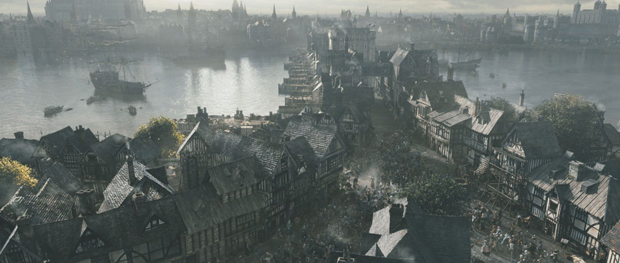
Elizabethan London

Elizabethan London
Tyburn was an infamous execution spot west of London, used since medieval times. The Tyburn "tree" - a unique, multi-person gallows - erected in 1571 became a popular public spectacle, drawing crowds of thousands.Tyburn Tree blog is less blood-thirsty but hopefully topical, interesting and informative, if slightly bent to my personal topics of interest - books, writing, history, technology, with a smattering of politics and dash of pop culture, science and the downright strange. So "take a ride to Tyburn" and see what happens...
Showing posts with label film. Show all posts

Saturday, April 1, 2017

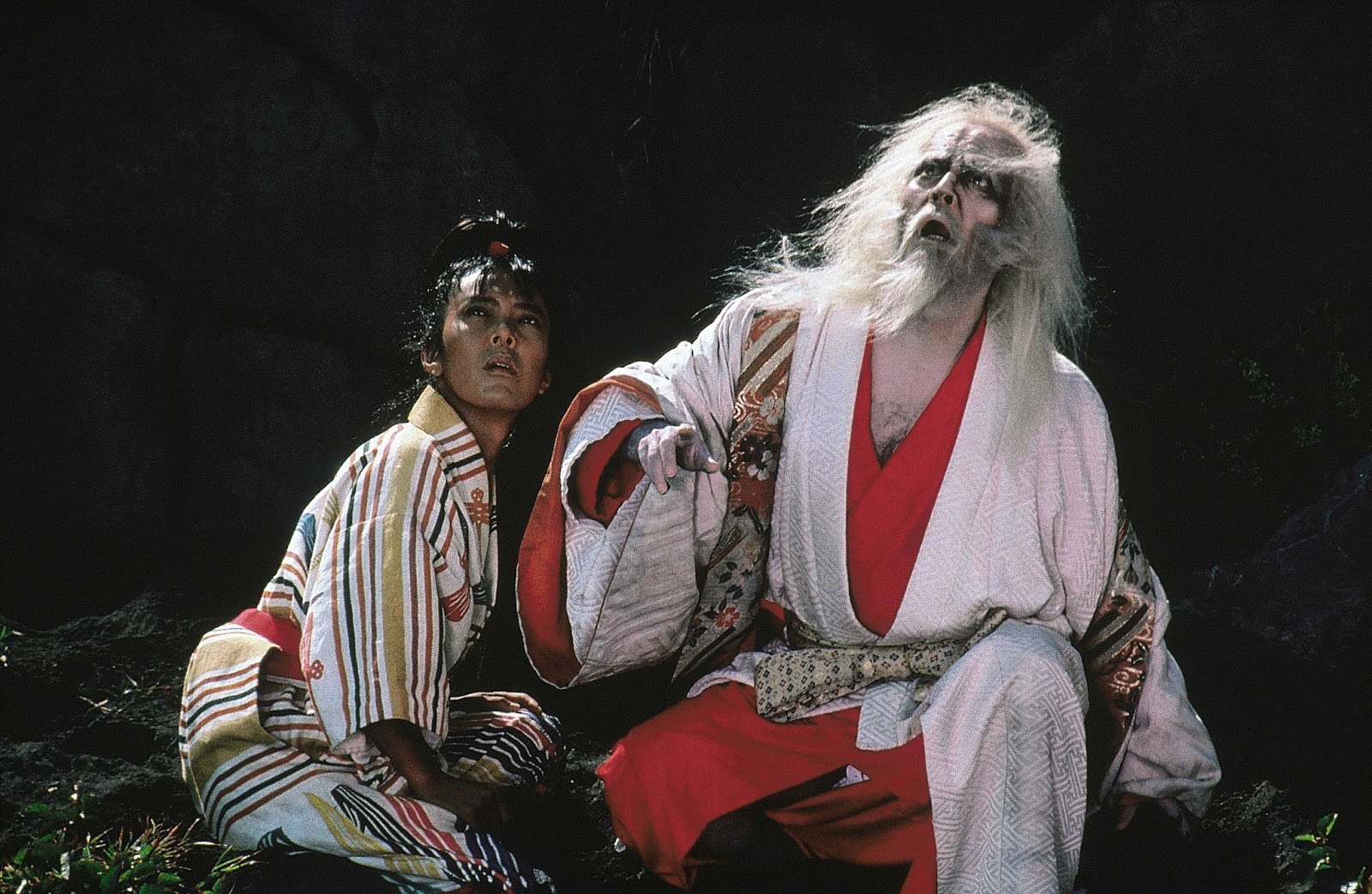
Shakespeare at the Movies: Ran

Ran (1985)

Director: Akira Kurosawa
Stars: Tatsuya Nakadai, Akira Terao, Jinpachi Nezu


“As flies to wanton boys are we to the gods. 
They kill us for their sport.” 
-Shakespeare, King Lear

Ran is one of acclaimed director Akira Kurosawa’s most visually stunning films. An epic, bloody, colourful, and apocalyptic piece of celluloid, the film garnered Oscar nominations for Best Director, Art Direction, Cinematography, and Costume Design (won!).

Ran (the Japanese word for “Chaos”) is loosely based on King Lear, Shakespeare’s cautionary tragedy focused on the dangers of power, succession, family ambition, madness and loyalty.

Ran tells the tale of Hidetora Ichimonji, a powerful but aging warlord who decides to retire from ruling and divide his kingdom between his three sons. Hidetora will retain his role as the Great Lord.  His son Saburo objects, noting that Hidetora himself often used questionable means to retain power and to expect his sons to remain loyal was foolish. For his pointed advice, Saburo is exiled and the lands divided between the two remaining sons.

As expected, once the power is divided among his remaining two sons, Hidetora is ousted as Great Lord, flees to the Third Castle (empty as it belongs to the exiled Suburo. Besieged in the castle by the armies of his two sons, his samurai slaughtered, the castle in flames, Hidetora succumbs to madness and escapes the conflagration, to end up wandering the wilderness, haunted by visions of the many people he had butchered in his quest for power.

Son #1 (Taro, the eldest) is killed by Jiro (Son #2)’s general, and Jiro, naturally enough, steps up to assume the position of Great Lord. He also ends up in an affair with his dead brother’s manipulative widow Kaede, who tries to suborn him into murdering his own wife, who flees. At this point Jiro also decides to dispatch assassins to finish off his troublesome (and now quite mad) father Hidetora.
At this point, not one but three armies are entering the field – Saburo (Son#3), re-appears alongside two rival warlord allies. Jiro makes a hasty peace but then promptly backstabs his meddlesome brother as soon as his brother hears that Hidetora is alive and insane. Saburo rides off to rescue Hidetora, Jiro looses his assassins, rival warlords and armies clash and in short order Saburo recovers Hidetora, mends his broken relationship, helps him recover from his madness, just in time to be promptly and thoroughly murdered by Jiro’s assassins.

Whew.

Hidetora dies, stricken by the loss of his only loyal son. Jiro’s fugitive wife dies, murdered by assassins. Jiro’s general Kurogane (who so kindly took care of Son #1 for Jiro) finds out about how Son #1’s widow manipulated events and promptly decapitates her in a fit of honourable angst.  In a final bloody, flaming conflagration, Jiro, Kurogane etc. all go down in a blaze of…well, not glory for sure, chaos springs to mind, when the rival warlords besiege the castle in the final doomed battle.
In any case, there is a great heap of bodies, a nice funeral procession and some sad symbolic irony at the end.

So wow.

Visually dazzling, Ran is an epic, sweeping, stylistic rendering of the Lear tale, pulling out the themes of war, chaos, loyalty, madness and nihilism into a masterclass of film. Ran is chock full to the brim with suffering, horror, murder, hypocrisy, and the doomed.
Lear was written by Shakespeare in 1606, a time of particular caution in England as Queen Elizabeth had died childless and unmarried in 1603.  She was succeeded by the young King of Scotland James I, son of her executed rival Mary, Queen of Scots.  The advent of a new King, after 44 years of Elizabeth's rule, was a shocking herald to a new age and a new political reckoning.  It was not helped by the bloody aftermath of the Gunpowder Plot  in 1603, a failed assassination attempt on Parliament and the new King that shook the foundations of the nation to its core.

The nature of power, succession and how a kingdom can teeter into chaos dominates the themes of Lear, bringing the differences and potential dangers faced by the new regime into sharp focus. Kurosawa himself noted that Ran was intended as a powerful metaphor for nuclear war and the grinding, systemic and industrial quality inherent in the advent of modern warfare. It is notable in that it is a samurai epic where almost every important figure dies by gunfire, not by sword.

It is a telling story. And one well worth a watch.


“This is the excellent foppery of the world, that,
when we are sick in fortune,--often the surfeit
of our own behavior,--we make guilty of our
disasters the sun, the moon, and the stars: as
if we were villains by necessity; fools by
heavenly compulsion; knaves, thieves, and
treachers, by spherical predominance; drunkards,
liars, and adulterers, by an enforced obedience of
planetary influence; and all that we are evil in,
by a divine thrusting on: an admirable evasion
of whoremaster man, to lay his goatish
disposition to the charge of a star.” 
― Shakespeare, King Lear

Tuesday, February 2, 2016

Shakespeare at the Movies: Romeo + Juliet (1996)


Romeo + Juliet (1996)

Director: Baz Luhrmann
Stars: Leonardo DiCaprio, Claire Danes, John Leguizamo

Romeo and Juliet is probably the Shakespearean play most familiar to modern audiences due to the fact that so many schools are determined to ram the angsty, star-crossed teen lovers down high-schoolers throats, mainly I suspect, as an object lesson on how NOT to get stupidly infatuated and ruin your lives…

It has been re-made countless times (most recently in 2013) but certain film versions stand-out for their more unique vision of the Bard’s tale. West Side Story meshed Romeo & Juliet into a street-gang themed musical, while Franco Zefferilli’s lush version leveraged a bevy of 14th century locations and teen-aged stars.  Baz Luhrmann’s frentic, janky, modern-day revision of the play brings Shakespeare into the crux of the MTV generation.

Romeo + Juliet is set in the fictional location of Verona Beach, a hip, decrepit-looking beachfront city where “Two households, both alike in dignity” face off as corporate and familial rivals. The Capulets and the Montagues may be rival crime families, hiding their illegal activities under a number of fronts, but the story doesn’t explicitly note that fact. The tone is set from the start with the famous introduction intoned by a TV anchorwoman, accompanied by staccato repetitions that seem designed more to scream out how different this version promises to be, rather than for any useful purpose.

Romeo (played by a very young looking 21-year old DiCaprio) is one of the Montague boys –most of them a set of beefy, frat house-looking group of “brahs” that are intended to contrast sharply with the more Latino/Hispanic Capulets.  After a gas station altercation between Benvolio (Romeo’s cousin) and Tybalt (played with hissing enthusiasm by John Leguizamo) turns violent, the warring families are warned to hold the peace by Captain Prince, the Chief of Police.

Enter Mercutio (Harold Perrineau, more recently known for his portrayal of the gang leader Pope on Sons of Anarchy), who talks the lovelorn Romeo and the Montagues into crashing a costume ball being given by the Capulets. He also slips Romeo some Ecstasy.  Romeo wanders about like an extra from a Hunter S. Thompson book until he encounters Juliet (a luminous Claire Danes) and is instantly smitten. There is the requisite back-and-forth, some threats from Tybalt, a quick stolen kiss and the famous balcony scene when Romeo sneaks back onto the estate and proclaims his love.

This is quickly followed by the arrangement of a secret marriage between the two teens, an effort that goes somewhat awry when Tybalt intervenes and attacks Romeo. Mercutio steps in and, inevitably as one of the more interesting characters in the movie, is mortally wounded in his intervention. He curses both families and dies. Romeo, in a fury, chases down Tybalt in a car, crashes into Tybalt’s vehicle and then shoots Tybalt dead on the church steps.

Romeo, exiled from the city, stews, while Juliet frets and eventually decides (with the help of Father Lawrence, played by Pete Postlethwaite) to fake her own suicide via a drug rather than be forced into another marriage. A message is sent to Romeo but, alas, the message goes astray. Romeo finds his love “dead”, and promptly kills himself with poison (no spoiler warning here – it’s been 400 years). Juliet wakes, finds Romeo dead, picks up his Dagger 9mm, and shoots herself.  End scene. Call the coroner.

Romeo + Juliet certainly earns points for style – any movie that can sneak an iconic Prince song into a choir scene has all the requisite style points you can ever need – but it is uneven as a film at best. Baz Luhrmann’s direction is often jarring, over-saturated and chaotic, which doesn’t lend itself following the fast-moving romance or the Shakespearean dialogue.  The tempo of the film is offsetting and, bluntly, feels discordant. The best scenes are the few that he slows down in.

This off-tempo sense also exhibits itself in the cadence and style of speech in the film. There seems to be a deliberate attempt to make the language conversational at points, an attempt that interrupts the flow and pattern of the dialogue. It’s particularly notable when you contrast it with the more polished and traditional cadence of Shakespearean trained actors who can capture the rhythm and flow of the longer, archaic language. The staccato interruptions, irregular pauses and copious shouting make the play actually harder to follow.

The acting, by contrast, is mostly solid, one of Romeo’s cousins excepted… “I will bite my thumb at them, which is a disgrace to them, if they bear it.” He played this scene about as exaggerated as it possibly could be. As this is very early in the film, my assumption is that the director was deliberately "stage-setting" in his usual patented style. It would be interesting to see how this movie concept might have played out in the hands of a more subtle and nuanced director.

Both DiCaprio and Claire Danes provide very solid portraits of the two lovers. Claire Danes in particular plays Juliet as a wide-eyed, flirty, very typical teenage girl who finds herself pulled into this incandescent relationship. The Nurse (Miriam Margolyes) is particularly good and under-appreciated in a role usually played much more broadly as comic relief. Strangely enough, a massively young Paul Rudd pops up as Juliet’s arranged groom Paris.

One of the other very neat ideas the film uses is to re-brand the handguns, rifles and other firearms used by both families as variously Rapier 9mm’s, Dagger .45’s, a LongSword rifle and so forth. This is a clever and timely switch that is used to great effect as the preening young ruffians of both families parade about waving customized handguns and uttering archaic threats “Part, fools! Put up your swords. You know not what you do!

Romeo + Juliet.  Not bad.  Not great by any measure, but an interesting take on an oft-told, oft-performed piece of work.

Saturday, December 19, 2015

Elizabethans at the Movies, Part 4

Here’s Part 4 of my Elizabethans at the Movies series, taking a quick look at the most recent crop of modern Elizabethan-era films.

Apologies for not getting this posted earlier in the week but the holiday season and life intervened.  In any case, here is Part 4, where we look at The Other Boleyn Girl:


The Other Boleyn Girl (2008)

Director: Justin Chadwick

Stars: Natalie Portman, Scarlett Johansson, Eric Bana

The Other Boleyn Girl is a much romanticized, soap operatic account of the events surrounding Henry VIII’s tempestuous relationship with Anne Boleyn, the subsequent divorce with Catherine of Aragon and Anne’s eventual rise to marriage and the position of Queen, followed by her abrupt fall, trial and execution.

The basic story centres around the ambitious Boleyn family – the uncle, the Duke of Norfolk, and Thomas Boleyn (the father) plot to introduce Henry VIII (Eric Bana, in a not particularly believable portrayal) to Boleyn’s daughter Mary (played by Scarlet Johansson) as a potential mistress (a most disquieting effort to pimp out his daughters…). Boleyn hopes to have position, titles and revenue as a reward for Henry’s possibly being able to sire a son and heir on his daughter. Henry duly becomes infatuated with Mary and becomes involved. Anne Boleyn (played by Natalie Portman) meanwhile secretly marries a nobleman, a marriage that Anne, fearing the King’s displeasure, rats out to her father and results in Anne being exiled to France and the marriage annulled. When Mary becomes pregnant, the Boleyn’s fear the King will lose interest, so they bring Anne back to keep the King’s attentions. Mary gives birth to a son but, alas, he’s a bastard, and so Mary and her new child are exiled to the country, while Anne replaces her sister as Henry’s new favorite. Anne pressures Henry to break with the Church and divorce Catherine, eventually he agrees, declares himself head of the church, has the marriage annulled and marries Anne Boleyn, who is now…wait for the drumroll…Queen of England. Anne gives birth to a daughter (Elizabeth, eventually to become Cate Blanchett..er…uhm…Queen Elizabeth) but fails to deliver to Henry the long-sought son and heir, for which he sundered the religious equanimity of his kingdom.

Fearing the King’s wrath over the miscarriage of his supposed son, Anne plots to father a child with her brother (spoiler: they don’t). The plot is reported, the two arrested for treason, incest and adultery. Her brother George loses his head, followed swiftly by Anne after a trial. Mary attempts to intercede but fails and is warned to no longer appear at Court. Henry VIII goes on to marry his next wife (Jane Seymour), Mary returns to her country exile, helping to raise Elizabeth, and Anne gets to fatally meet the Swordsman of Calais…

The Other Boleyn Girl is, as with so many of the Tudor/Elizabethan period pieces, gorgeous to watch. Sumptuous costumes, terrific historical locations and tolerable acting make what is a fairly pedestrian and overly melodramatic script work as a decent, if not particularly memorable film. There is nothing terrible in this movie, but nothing particularly memorable either. Both Portman and Johansson give strong performances as the Boleyn ladies but they are somewhat undone by the overall structure and pace of the movie. There seems to be little urgency around their actions (at least until Portman suddenly begins suggesting incest to her brother as a solution to their problems – a moment that feels highly forced and bluntly, illogical).

Historically there are a number of issues with this film, aside from the usual time-compression and conflation that almost all Hollywood historical dramas are guilty of when brought to the screen. The film understates Mary Boleyn’s role as a mistress, deliberately creating an air of innocence around a woman who historically had purportedly been the previous mistress of the King of France (who also, in the classy manner of so much royalty, described her as “a hackney” because she was fun to ride). The dual portrait of the Boleyn sisters as either naive innocent vs. scheming vixen ends up being both shallow and historically inaccurate.

As an added bonus, the film doesn’t do Henry VIII much justice either. The King is generally treated as a smoldering sex obsessive, slipping from one fruitless, frustrated dalliance to the next, trying in vain to beget an heir. Henry VIII was a complex character in his own right – vain, very much a man who believed in his own eminence and God-given divine right to rule but clever, manipulative and often mercurial.  The Henry VIII in The Other Boleyn Girl is a one-dimensional shade of the real character.

Overall The Other Boleyn Girl is a decent, if uninspired film, with good acting, nice sets and an overly melodramatic plot line that frankly, doesn’t treat the material with the respect it probably deserves. If you are looking for a more interesting take on the era, check out the miniseries The Tudors, which offers a longer and more nuanced look at the characters (particularly Anne Boleyn, archly acted by Natalie Dormer) and the era, although it also suffers from significant historical accuracy.

Ranking: B- / C+

Tuesday, December 15, 2015

Elizabethans at the Movies Part 3

Here’s Part 3 of my Elizabethan's at the Movies series taking a quick look at the most recent crop of modern Elizabethan-era films. Today:

Shakespeare in Love (1998)

Director: John Madden

Stars: Gwyneth Paltrow, Joseph Fiennes, Geoffrey Rush, Tom Wilkinson

Shakespeare in Love is an exceptionally enjoyable film (though whether it deserved to win Best Picture in a year with Saving Private Ryan and Life is Beautiful is very debatable). Oddly enough, 1998 saw Joseph Fiennes playing Shakespeare while simultaneously playing Robert Dudley in Elizabeth alongside Geoffrey Rush playing theatre-owner Henslowe and Francis Walsingham. A good Elizabethan year for them both, I presume. (FYI some spoilers in the review I’m afraid…)


The movie is a romantic comedy that follows struggling playwright Will Shakespeare, suffering from penury, romantic loss, and one of the better cases of writer’s block set to film. Having sold a yet unwritten play to both Henslowe’s Rose Theatre and Burbage’s Curtain, Shakespeare must re-discover his muse, while simultaneously penning the epic Romeo and Ethel, the Pirate's Daughter. Meanwhile Viola de Lessops (Gwyneth Paltrow), a wealthy merchant’s daughter, disguises herself as a man (Thomas Kent) in order to audition for Shakespeare’s new work. The playwright follows the “actor” back to the de Lessop household and crashes the party being given for Lord Wessex, where he espies Viola (resuming her role as herself) dancing and is immediately smitten.

Inspired, he begins to write again and, as the play progresses, so does Shakespeare’s infatuation with Viola, which deepens into an affair when he discovers that she and Thomas Kent are one and the same.

Eventually Shakespeare discovers Viola is to be married to Lord Wessex, and Viola discovers that the playwright already has a wife waiting in Stratford, a very Shakespearean back and forth ensues that culminates in the performance of the tragic romance of Romeo and Juliet at the Curtain when Viola is forced to step into the role of Juliet when circumstances require it. Alas, the fates are destined to part the tragic lovers, with Viola married off to Lord Wessex and gone to the New World and Virginia. Shakespeare, however has re-inspired his muse and sets forth to write Twelfth Night.

One of the standout elements of the film is the dialogue, which is simultaneously snappy and clever. Here’s a brief excerpt of Henslowe facing down his creditors:

Philip Henslowe: Mr. Fennyman, allow me to explain about the theatre business. The natural condition is one of insurmountable obstacles on the road to imminent disaster.
Hugh Fennyman: So what do we do?
Philip Henslowe: Nothing. Strangely enough, it all turns out well.
Hugh Fennyman: How?
Philip Henslowe: I don't know. It's a mystery.

Overall this is a vastly more enjoyable look at Shakespeare than Anonymous was, although with its historical or literary accuracy served in broad strokes.  It is fun, light-hearted and soulful by turns, with more respect for the characters and the setting than Anonymous ever cared to display. It feels more Shakespearean and in tune with the Bard’s work. The acting is solid with both Paltrow and Fiennes offering superb work in their respective roles, supported by a vast array of excellent character actors that, oddly enough, includes Ben Affleck as Edward Alleyn, the premier actor in the Admiral’s Men. Affleck delivers what was my favourite line:

William Shakespeare: You, sir, are a gentleman.
Ned Alleyn: And you, sir, are a Warwickshire shithouse.

So what is inaccurate? Much, but more in realism than in approach. The film is set in 1593, which does fit with the timelines of when Romeo and Juliet was estimated to have been written and performed. Kit Marlowe did die in a Deptford tavern brawl in 1593 (knife through the eye in a dispute over the bill, although he was also, at the time, hanging about with several of Francis Walsingham's agents, so read into that what you will...), so the film gets its major key facts correct. Despite the ostensibly setting and era Shakespeare has a souvenir mug from Stratford-upon-Avon sitting on his shelf, and consults a doctor/astrologist/psychologist for advice on how to re-ignite his literary passions. These type of clever references abound and anyone with a knowledge of Shakespeare’s works will have an enjoyable time picking out all the many references and in-jokes.

As an added bonus, apparently the film is now in the process of being converted to a stage play, so the circle is now complete...

In sum, Shakespeare in Love is a witty, engaging and energetically fun film, and highly recommended!

Ranking: A

Tomorrow, The Other Boleyn Girl

Monday, December 14, 2015

Elizabethans at the Movies, Part 2


Here’s Part II of my Elizabethan's at the Movies series taking a quick look at the most recent crop of modern Elizabethan-era films. Today, only one entry:

Anonymous (2011)

Director: Roland Emmerich

Stars: Rhys Ifans, Vanessa Redgrave, David Thewlis, Rafe Spall

I’ll start with the blunt and brutal assessment that the plotline and claims of the film are a steaming crock of shit. It’s hard to look at anything else contained in this film without the nonsensical plotline obscuring the elements that work and the performances of the actors. Be advised, this review will contain spoilers….

The film advances the oft-cited theory that the plays of William Shakespeare were, in reality, penned by Edward deVere, the Earl of Oxford. That’s not really the reason for the plotline being a crock of shit, although it certainly contributes (and I know that there are any number of “Oxfordians” out there who will steadfastly argue the veracity of their theory, to which I will respond “prove it”, which usually meets with sputtering indignation and much spurious assumptions but no actual evidence).

The story postulates that Edward deVere was a literary prodigy, penning A Mid-Summer Nights Dream as a child, and later is forced to abjure himself from literature by his forced marriage to William Cecil’s daughter after murdering a servant that was spying on him (I know, a bit convoluted). Later, driven by his literary urges, he attempts to suborn playwright Ben Jonson into taking credit for his work, but eventually settles on a drunken, egotistic and bombastic actor named William Shakespeare.  Shakespeare eventually finds out who is supplying him the plays and in turn blackmails deVere for more funds (Will also murders Christopher Marlowe, who uncovers the secret).

Brace yourself, now it gets a bit more convoluted…De Vere, becomes romantically involved with Queen Elizabeth, purportedly fathering an illegitimate son in secret, who is adopted out by Cecil and eventually becomes Henry Wriothesley, 3rd Earl of Southampton. However, it turns out that this isn’t the first secret lovechild of Elizabeth. The first is (drum-roll) De Vere himself!

All of this incest/secret child nonsense leads to the climax involving the attempt to stir a popular rebellion against the nefarious Cecils who are controlling and manipulating the Queen to insure the succession of James I. The popular rebellion is led by the Earl of Essex and Southampton, ably supported by deVere penning Richard III as a attempt to drive the mob into a frenzy and overthrow the evil hunchbacked younger Cecil’s control over the throne.

So. Yeah. In a nutshell: craptastic.

What works – Elizabethan London has rarely looked as fine and dazzling as it does in Anonymous. The gorgeous CGI brings the city to life in a way not seen on the screen before. The sets and locations are terrific, the costumes wonderful, the energy and vibrancy of the stage at the Globe is fantastic.  The acting is solid, with Rhys Ifans pulling a soulful performance out of deVere, and Vanessa Redgrave as the elderly version of Elizabeth (this movie time-jumps wildly all over the place, did I fail to mention that?) is quite good. The other standout for me was Rafe Spall as the duplicitous William Shakespeare – actor, murderer, drunkard, blackmailer – but damned fun to watch.

History-wise this movie is, as stated, pretty much a crock. I won’t get into the documented evidence against practically everything the plot claims but, hey, it’s SUBSTANTIAL. You can review that online at your leisure. Some of it is fun to read but if you want a good, well-written documented and authoritative look at the whole Oxford vs Shakespeare fight, grab a copy of CONTESTED WILL by James Shapiro.

Overall terrible piece of film, beautifully made and acted.


Ranking: F

Tomorrow: Shakespeare in Love

Sunday, December 13, 2015

Elizabethans at the Movies

The Tudor and Elizabethan era has always been fodder for film-making, although it has dropped off considerably in recent years. The 1930’s saw Errol Flynn swashbuckling his way through the era in The Sea Hawk while Erich Wolfgang Korngold’s blaring trumpets set the tone. Flynn reappeared in The Private Lives of Elizabeth and Essex, while Charles Laughton gave the world an indelible portrait of Henry VIII eating a chicken.

Here’s a quick look at the most recent crop of modern Elizabethan-era films (note: I am not including adaptations of Shakepeare’s many works, we’ll save that for another day):

Elizabeth (1998)

Director: Shekhar Kapur

Stars: Cate Blanchett, Geoffrey Rush, Christopher Eccleston, Joseph Fiennes

Cate Blanchett stars as the young Elizabeth, ascending the throne in the wake of her half-sister Queen Mary’s death. The film looks at the early years of Elizabeth’s reign, following her as she adjusts to rule in the face of ambitious men seeking to marry her off or control her, Catholic opposition, intrigue and rebellion, attempted assassination and her purported romance with Lord Robert Dudley.

The film is, bluntly, gorgeous and sumptuous, with the sets, costuming and location shooting at numerous historic locales (Bamburgh Castle, Durham Cathedral, Bolton Castle, Haddon Hall and more) which gives the film a powerful verisimilitude. The performances are solidly terrific, particularly Cate Blanchett as Elizabeth growing into her power and position.

So how historically accurate is the film? The story conflates particular events, compresses and disorders others and in a number of cases, just seems to make stuff up wholesale in order to make a more gripping and tense storyline. Certain characters are jettisoned – one assumes for simplicity's sake. One egregious example is William Cecil (eventually to become Lord Burghley) whom history records as one of Elizabeth’s most stalwart and long-serving advisers. In the film, he is rapidly dismissed and shipped out to retirement in favour of the lean and hungry Geoffery Rush playing a superb version of Francis Walsingham, who actually served as Elizabeth’s foreign secretary and spymaster.  Joseph Fiennes as Robert Dudley (Earl of Leicester) suffers a similar fate of having his character diverge considerably from historical reality which I won't outline here but is wholly inaccurate.

Overall Elizabeth is a superb film, albeit with a number of limitations on its historical accuracy.

Ranking:  A-

Elizabeth: The Golden Age (2007)

Director: Shekhar Kapur

Stars: Cate Blanchett, Geoffrey Rush, Clive Owen, Jordi Molla

This second film picks up in the mid-point (roughly) of Elizabeth’s reign. Played again by the returning Cate Blanchett, the film follows Elizabeth dealing with the machinations of court, the ongoing plots of the imprisoned Mary, Queen of Scots and the imperial designs of Phillip II of Spain. Geoffrey Rush returns as the long-suffering advisor/spymaster Francis Walsingham, while Clive Owen makes an appearance as the dashing Sir Walter Raleigh, alternately trying to convince Elizabeth to fund his plans for a colony in Virginia, charming her (and her handmaidens) and generally playing the roguish buccaneer to the hilt. The film covers the eventual trial and execution of Mary, Queen of Scots, for treason in supporting an attempt on the Queen, and the subsequent attempt by Philip II to invade and conquer England with the Spanish Armada. 

Again Shekhar Kapur does a superb job in leveraging some terrific historic shooting locations which give the film an exceptional look and feel. The costumes are lavish, and the film generally wonderful to watch, in particular the soaring camera angles give the the viewer a birds-eye view from above, showing off the brilliant costumes and the vaulting locations.  The storyline and the acting seem somewhat less effective though Cate Blanchett is solidly in form playing a more austere and controlled Elizabeth, one that tends to watch with detachment and wry amusement, the endless dance of potential suitors. Viewers are left with a sense that she understands her role and her power better than any one else and she gives an excellent and believable performance.

History-wise, the accuracy of the film is questionable in both cause-and-effect. The film-makers re-paint the Babington plot (which is treated as a straight-up and deliberately failed assassination attempt) as a devious Spanish attempt to bait Walsingham and Elizabeth into executing Mary, thus giving them an excuse for launching the Armada. Similar to the first film, The Golden Age again conflates and combines key characters and events – in this case Sir Walter Raleigh and Francis Drake are stuffed into Clive Owen’s role and set out to destroy the Armada with fireships (which Elizabeth gets to conveniently watch cliffside after giving her historic speech at Tilbury). It made for more movie drama, but bad history…

Overall an enjoyable, if inaccurate bit of cinema!

Ranking: B+

Tomorrow....Anonymous!