Elizabethan London

Elizabethan London
Tyburn was an infamous execution spot west of London, used since medieval times. The Tyburn "tree" - a unique, multi-person gallows - erected in 1571 became a popular public spectacle, drawing crowds of thousands.Tyburn Tree blog is less blood-thirsty but hopefully topical, interesting and informative, if slightly bent to my personal topics of interest - books, writing, history, technology, with a smattering of politics and dash of pop culture, science and the downright strange. So "take a ride to Tyburn" and see what happens...

Monday, August 6, 2012

Coverspace

Several months back I used Lulu.com to pull together some reader copies of The Jesuit Letter that I could distribute to people and get feedback on the book.

Aside from discovering that no matter how much editing I do, I still manage to find additional typos right after having 10 copies printed....I found myself noticing and attending more carefully to the role of book covers.  The cover I pulled together for The Jesuit Letter was literally just that - pulled together from a couple of off-hand images I had and dropped onto the Lulu template...but this was a for a set of personal reader copies, not for sale or appeal to a wider audience, so I spent very little time considering what to incorporate.  Not being a designer and using a very limited Lulu template, the cover is alright for the use for which it was intended.

But it certainly doesn't do the job it should.

The saying "you can't judge a book by its cover" might be nominally true but I suspect much of the time you can and do judge a book by its cover.  A powerful, interesting or evocative cover can catch the eye and set the tone for the book.  It is, I suspect, an essential component in determining if someone browsing in a bookstore, library, or online, decides that this particular volume merits a closer look.

Certain book covers tend to stick in the mind and help build a compelling and intriguing picture of the book and the story for the reader.  So what works in a good cover? 

It is fundamentally subjective to the reader but there are a number of key elements that are oft cited on design sites.  The basic rules of cover design seem to boil down to the following:

Clarity - A cover should reflect the identifying points of the genre - for example, a reader should be able to easily distinguish between a western vs. a romance or a horror novel (although there may be overlap if the story has elements from multiple genres or crosses genres).  Recognizable identifying points provide context for the reader and help them distinguish the type of books that they are looking for.  They will recognize and cue on the key cover elements.  Romance novels would be nowhere without the pair of entangled lovers to instantly cue in the reader to the torrid promise of the story inside.

Visual integrity - The colours, font, images layout and style need to be an integrated design.  A lack of visual integrity results in a design that may be discordant or incoherent, lacking the strength of message and recognition that you want the book cover to convey to readers.

Expression & Information - A cover needs to express what the book is about or unique and important elements of the story.  This may be the setting, the characters, plot, motvivaton or critical event (i.e. a murder, a prizefight, a fishing trip etc).

Differentiation and Emotion - The cover needs to strike a balance between the recognizable cover elements that readers are familiar with, and provide an emotional appealling point of differentiation - something that makes that particular cover stand-out from the twenty others surrounding it on the bookshelf.

Ideally all of the above elements are integrated into your design to ceate a compelling and interesting whole that readers will find impossible to resist.

So what covers work?  As noted, everyone's tastes are very subjective.  Here's  short sampling of several that stuck in my memory:


Looking for more insight or info on what type of covers work?  Five minutes on Google uncovered a vertiable cornicopia of book cover information.  For starters, visit The Book Cover Archive for a terrific compilation of exceptional book design covers.

For a self-publishing writer, the best approach would be to examine and analyze covers from your genre, ideally bestsellers or similar books that generated buzz, and see what elements of their covers worked for you.  Breakdown what elements worked for you and why, and try to see how the cover designs attracted your interest or attention (i.e. colour, typeface etc.).  Once you have an idea of what approaches seem to generate the more positive response, you can start to think about what your cover needs to reflect.

Then tell your designer.


Tuesday, July 24, 2012

Beyond

From now on we live in a world where man has walked on the Moon. It's not a miracle; we just decided to go.
- Tom Hanks


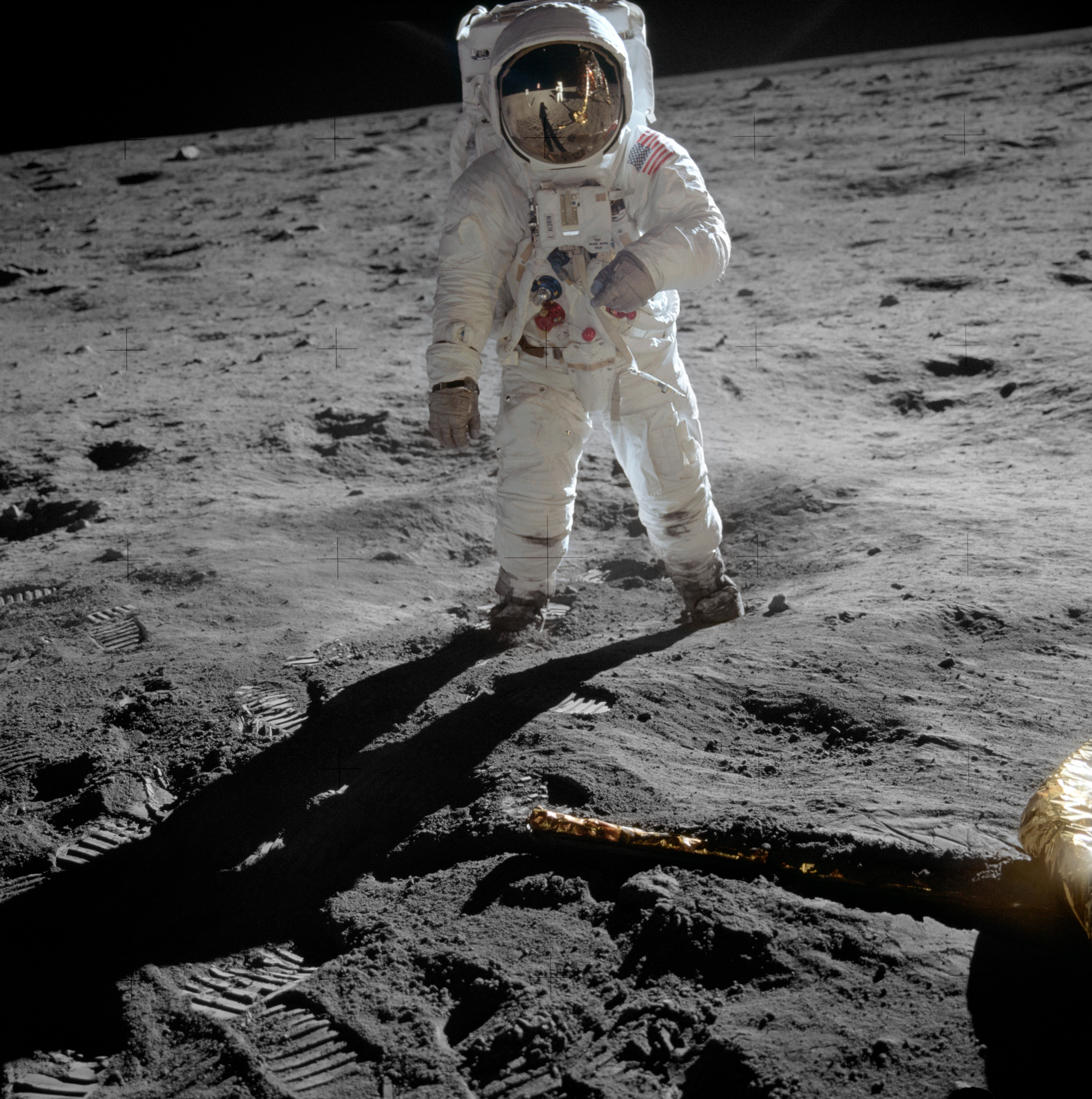
This week was the forty-third anniversery of the Apollo 11 moon landing.  The moon landing, old news as it is treated today, was probably one of the most seminal dates in human history.

Crew of Apollo 11:
Commander Neil A Armstrong
Command Module Pilot Michael Collins
Lunar Module Pilot Edwin "Buzz" Aldrin Jr.

From July 20th 1969 until December 13, 1972, a dozen men walked on the moon.  It's stunning to think they did so using less computing power than a typical wireless phone can use.

And in the forty years since, no human has left orbit.

It could be seen as depressing, not having followed the path we originally trod but in those forty years, unmanned space exploration has exploded, reaching out to Mars, Jupiter, Saturn and beyond.  Voyager 1 will become the first man-made object to leave the solar system and venture into true interstellar space.

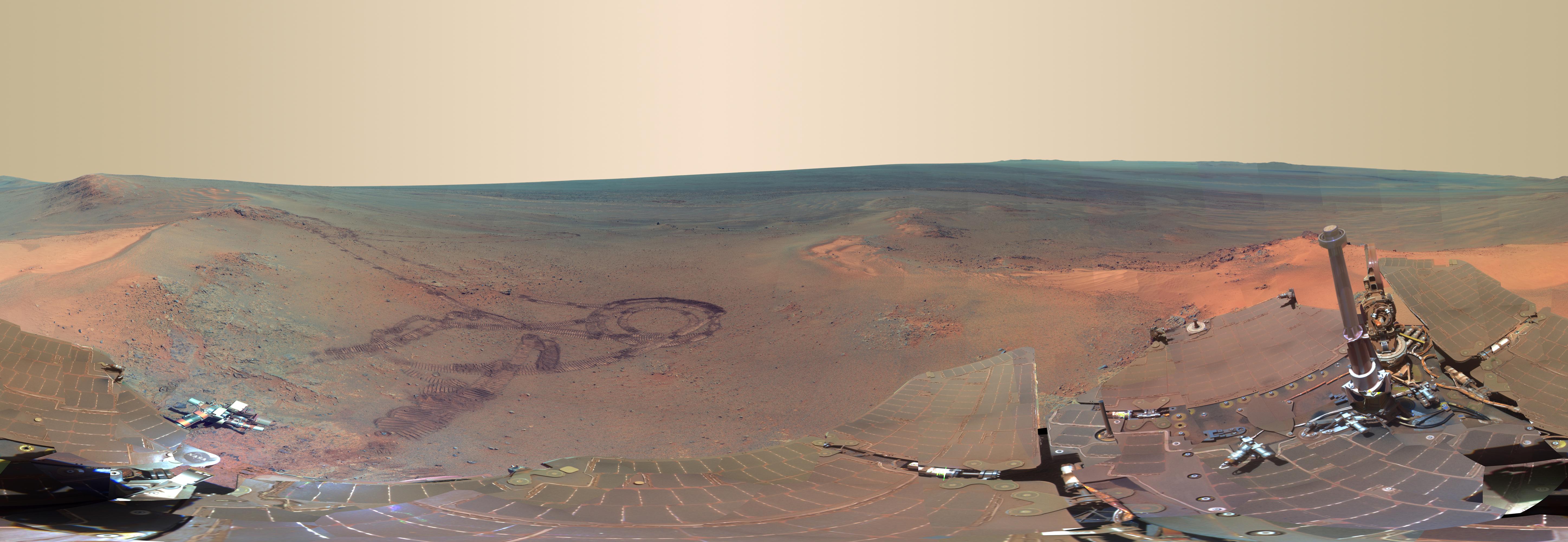
Last week NASA released an astonishing panoramic photo from Mars, taken by stitching together 817 images from the Mars Rover Opportunity, located at Endeavor Crater, Greeley Haven near Cape York.  Opportunity is currently on Day 3,022...ON MARS.  Keep repeating that fact in your head.


What's my point?  It's good to reach beyond your grasp, to outstretch your talents and chase the impossible and the improbable as far as you dare.

Passage to India

O sun and moon and all you stars ! Sirius and Jupiter !
Passage to you !

Passage, immediate passage ! the blood burns in my veins !
Away O soul ! hoist instantly the anchor !
Cut the hawsers -— haul out -— shake out every sail !
Have we not stood here like trees in the ground long enough ?
Have we not grovel’d here long enough, eating and drinking like mere brutes ?
Have we not darken’d and dazed ourselves with books long enough ?
Sail forth —- steer for the deep waters only,
Reckless, O soul, exploring, I with thee, and thou with me,
For we are bound where mariner has not yet dared to go,
And we will risk the ship, ourselves and all.

O my brave soul ! O farther farther sail !
O daring joy, but safe ! are they not all the seas of God ?
O farther, farther, farther sail !


- Walt Whitman

http://photojournal.jpl.nasa.gov/catalog/PIA15689 - All images courtesy of NASA.

Thursday, July 19, 2012

Lyrics

I was watching The Hangover 2 on the weekend and one piece of music they played during the show struck me.

The song was Billy Joel's Downeaster Alexa.  It seemed a strange song to encounter in The Hangover 2.  I assume they used it for atmosphere around transitioning the film from the US to Thailand but the story being told in Downeaster Alexa seemed somewhat at odds with the chaotic and lurid ramble of The Hangover.

What struck me was how effective songs are at storytelling.  Songs by their nature convey a great deal of their emotional content and mood via the music however like poetry, the lyrics need to convey the picture, character, setting and conflict in very tight, often restrictive formats.  The result is powerful, evocative writing, often pared down to the most basic and foundational elements.

Downeaster Alexa lays out story of trying to eke a living as a commercial fisherman on the rugged north-east coast of the United States.


It sets the high water mark for the loss of home, tradition, and livelihood - all driven down due to the cost of living, property, loss of fish, and restrictions.

The story culminates with the realization that it can't continue, that the life that was, is no longer.

I was a bayman like my father was before
Can't make a living as a bayman anymore
There ain't much future for a man who works the sea
But there ain't no island left for islanders like me


There are a number of songwriters who seem to double as story-tellers.  Some might claim that all songs are designed to communicate a specific story or an emotional state but I don't necessarily agree.  A strong storyline for a song implies something beyond just rhythm and repetition.  When I think of songs that evoke a strong story, I tend to think of songs with genuine nuanced character like Neil Young's Unknown Legend:


Somewhere on a desert highway
She rides a Harley-Davidson
Her long blonde hair
Flyin' in the wind


Robbie Robertson's song Somewhere Down the Crazy River pulls character and setting out of the first section with vivid spark and verve:

Yeah, I can see it now
The distant red neon shivered in the heat
I was feeling like a stranger in a strange land


Springsteen's Promised Land does the same, painting a picture of bleak economic hardships and loss, coupled with an ongoing flicker of hope.

On a rattlesnake speedway in the Utah desert
I pick up my money and head back into town


One element that all the artists cited seem to have in common is purposefulness.  Nothing in the songs appears to be filler or fluff, each lyrical element seems tightly held in exactitude and care.  Song lyrics require that description be pared down to elemental essentials.

As a writer, I suspect many of us could take similar lessons from lyricists in our editing and our prose.  Cutting the non-essential, paring down to the impactful elements that drive setting, character, situation and emotion.  Ernest Hemingway famously wrote a six word short story: 

For sale: baby shoes, never worn.

It is said he called it his best work.  I suspect he would have made a good lyricist.

Wednesday, July 11, 2012

This is Jake. 

He's here for no particular reason aside from the fact that he is irrepressibly cute.

Friday, July 6, 2012

Openers

Opening lines are among the trickiest elements for a writer to put forward.

A good opener sets the tone.  It sounds trite but capturing that opening tone within the space of a single line can be an exceptional challenge.  It is very easy to drive yourself cleanly into Bulwer-Lytton territory ("It was a dark and stormy night.") without even noticing.  I've done it several times and once it has been pointed out by the outside observer, it is often shockingly, glaringly obvious that you are now deep in the weeds.

So what makes a good opening?  The answers are as varied as there are openers however one thing tends to predominate - having an opening line with an intriguing, evocative or substantive hook.  The hook is what draws you in, drive the reader's attention and ideally pulls them into the next sentence...and the next one and so on.

"The sky above the port was the color of television, tuned to a dead channel." —William Gibson, Neuromancer

Gibson is an exceptional writer and in the space of a single sentence he manages to evoke a multitude of the key elements that inhabit his story - technology, a modernized bleak sense of emptiness, and a brush of the familiar, a future (television) that all readers can readily associate to and understand. 

There is one school of thought that lays claim, as per the Bulwer-Lytton example, that providing a descriptive sentence as an opener is not a good approach, that it falls under that "purple prose' category but I disagree.  I suspect a strong descriptive passage can and does work as an opener, if used effectively.  One example is Richard Adam's classic Watership Down.

"The primroses were over."

The sentence aptly presages the changing world that the characters face.

In developing The Jesuit Letter, I went through several variations of the opener.  Prior to adding the prologue as an opening chapter the opening was:

"The nudge in the ribs was short of a kick, but not by much"

This was a straightforward intro into the character and his situation, with the sentence meant to spark an interest as to the question of just why it was so close to being a kick, who was being almost kicked and why.

After adding in a Prologue to further the storyline, the opening was changed to:

"The April dawn was grey, damp and muddy and tinged with the mixed smell of early spring and winter’s rot. "

This was a nice descriptive sentence and keyed up two of the themes around growth and death but it failed to have a particularly strong hook and, shades of Bulwer Lytton, focused on the description rather then a hook.  After receiving some feedback from a helpful agent, I re-visited it and it was re-written.

"He hoped it had been a clean death." 

This provides a much stronger and more interesting hook and pulls the reader into wanting to determine why, who and how.

Whether it stays or is re-worked again, only time can tell.

The American Book Review has a list posted of the top 100 opening lines starting with "Call me Ishmael.." from Moby Dick and ending with The Red Badge of Courage.  I can't claim to an acquaintenance with many of the books on the list and whether you agree with the list or not is entirely subjective, but there are some great opening lines included. 

Here's a few openers (aside from the Gibson quote above which is also on the top 100 list) that have caught my eye over the years:

"He was born with a gift of laughter and a sense that the world was mad."  - Raphael Sabatini, Scaramouche 

“No one would have believed, in the last years of the nineteenth century, that this world was being watched keenly and closely by intelligences greater than man’s and yet as mortal as his own; that as men busied themselves about their various concerns they were being scrutinized and studied, perhaps almost as narrowly as a man with a microscope might scrutinize the transient creatures that swarm and multiply in a drop of water.”  - H. G. Wells, War of the Worlds 

"Many years later, as he faced the firing squad, Colonel Aureliano Buendía was to remember that distant afternoon when his father took him to discover ice." —Gabriel García Márquez, One Hundred Years of Solitude

“Midway in our life’s journey, I went astray from the straight road and woke to find myself alone in a dark wood.” - Dante,  The Inferno

"In a hole in the ground there lived a hobbit." - JRR Tolkien, The Hobbit

"Women, how they do haunt this tale." - Bernard Cornwell, Excaliber

Feel free to drop in any of your  thoughts, or your own favorite opening lines in the comments below.

Thursday, June 28, 2012

The Curtain Rises....

Earlier this month archaeologists in London reported that they had uncovered the remains of the Curtain, one of the first permanent theatres built in London.
Remains of Shakespeare’s Curtain theatre are uncovered in Shoreditch, London

Opened in 1577 in Shoreditch, the theatre became home to Lord Chamberlain's Men  - William Shakespeare's troupe - in 1597.  It is widely believed that both Romeo and Juliet and Henry V were premiered on the Curtain's stage.

Both the Curtain and its neighbour, the Theatre, were built outside of the precincts of London proper, beyond the authority of the very Puritan Corporation of London which despised the theatres.

Sir John Spencer, Lord Mayor of London, vividly described the theatres in 1594 as "places of meeting for all vagrant persons and maisterles men that hang about the Citie, theeves, horsestealers, whoremoongers, coozeners, connycatching persones, practizers of treason and other such lyke."

The Curtain itself was immortalized by Shakespeare in Henry V:

O for a Muse of fire, that would ascend
 The brightest heaven of invention,
 A kingdom for a stage, princes to act
 And monarchs to behold the swelling scene!
 Then should the warlike Harry, like himself,
 Assume the port of Mars; and at his heels,
 Leash'd in like hounds, should famine, sword and fire
 Crouch for employment. But pardon, and gentles all,
 The flat unraised spirits that have dared
 On this unworthy scaffold to bring forth
 So great an object: can this cockpit hold
 The vasty fields of France? or may we cram
 Within this wooden O the very casques
 That did affright the air at Agincourt?


That "wooden O" is now reduced to a few foundation walls and yard, but in these tantalizing clues, archaeologists hope to fully understand the true dimensions and structure of the building.

If the Renaissance in Italy expressed itself in art and architecture, the Renaissance in England was theatrical and literary in its expression.  The Elizabethan theatre and playwrites set the stage for 500 years of popular entertainment and literature, helping tread the path to modern fiction and the multiplex.

For more info, check out the article in The Guardian.

Wednesday, June 20, 2012

Basilica: The Splendor and the Scandal: Building St. Peter's


Basilica: The Splendor and the Scandal: Building St. Peter's by R. A. Scotti


Despite a great deal of background on the history of the period, I think I failed to appreciate how much of the Reformation was driven by the cost overruns of a construction project...

The design, development and building of the Basilica of St. Peter must stand as one of the superlative achievements in the history of mankind. Begun in 1506 and completed in 1626, the Basilica reads like a "who's who" of Renaissance artistry and architecture including Bramante, Michelangelo, Bernini, and Raphael, among countless others.

Scotti's book is an engaging, deftly written page-turner that delves into both the technological and architectural challenges and into the characters and personalities of the architects, builders, artists and their Papal patrons that, over 120 years, created a sublime masterpiece.

I recommend the book and, if you have (as I have) never had the opportunity to visit in person, check out the terrific virtual tour online for a first-hand look. It is spectacular. 

All images used in this post are courtesy of the Vatican website (http://www.vatican.va).