“I never prospered since I forswore myself at primero. Well, if my wind were but long enough to say my prayers, I would repent.”
– Falstaff, The Merry Wives of Windsor by William Shakespeare
Gambling games in the Elizabethan era variously included tossing the bales (dice), shrove-groat, venter point, cross-and-pile (all coin-tossing games), and wide variety of card games such as gleek, cent, foot-savant, maw, bone-ace, monchance & primero in all its many variations. Queen Elizabeth herself was inordinately fond of card games and played regularly (she apparently took Lord North for £33 playing Maw in August, 1577).
Technically gambling and games (along with bowls, tennis & football among others) were forbidden by law. The government instead encouraged all young males to practice the more martially useful sport of archery, an activity that was rapidly waning in face of gunpowder. The statutes on gambling were so commonly broken that the Queen eventually licensed the Groom-Porter's office in 1578 to allow licenses for gaming establishments, a very lucrative prerequisite for the occupants of the position.
 |
| The Cardsharps, by Caravaggio, c 1594 - Note the player in the gold-striped doublet is cheating.... |
Cheating was wide-spread and common, enough that a very specialized vocabulary for the many different variations has emerged and was in common language usage, often by Shakespeare and other playwrights. Cogging & foisting, cozening, cony-catching, bar-dice, bristle-dice, card chopping, highman & lowman and contraries were all actively in play. False dice in particular were a concern (with at least 14 distinct variations cited) of the Groom-Porter's office as it cut into their own role as a monopoly supplier for licensed dice and cards.
"If you play among strangers, beware of him that seems simple or drunken; for under their habit the most special cozeners are presented, and while you think by their simplicity and imperfections to beguile them...you yourself will be most of all overtaken." - Reginald Scott, Discovery of Witchcraft, 1584
Elizabethan-era card decks were commonly imported from France or Germany. The earliest, most well-known designs were from Rouen, France by Pierre Marechal. Spanish and Italian cards typically used 4 suits - chalices, swords, coins, and batons, while Germanic cards displayed hearts, acorns, hawk-bells, and leaves. The French (and subsequent English cards) used the familiar hearts, spades, diamonds and clubs of today, although the cards did not display any numerals.
Facsimile based on playing cards by Pierre Marechal of Rouen, c.1567
Published by Rose & Pentagram Design, 2006. www.historicgames.com
These French card designs formed the basis for the subsequent development of English card decks after foreign cards were banned in 1628. Very few cards remain extant today, only about a dozen cards from the 1590's have survived.
Attitudes of the Puritan authorities towards any type of recreational activity, particularly gaming of any form, was generally negative. Even bowls, the famous pastime Sir Francis Drake was engaged in 1588 while waiting for the arrival of the Spanish Armada, was problematic. Bowling alleys are described in School of Abuse (1579) by Stephen Gosson as "privy moths that eat up the credit of many idle citizens, whose gains at home are not able to weight down their losses abroad, whose shops are so far from maintaining their play, that their wives and children cry out for bread, and go to bed supperless oft in the year."
Of all the card games, Primero was probably the most popular and widespread 16th century card game. The game originated in Italy or Spain. Widespread across Europe, it is widely considered one of the precursors of modern Poker. The game was very fashionable during the Tudor and Elizabethan eras.
Primero is commonly played with four to six players, and with a 40-card deck (the 1567 Rouen deck pictured above, of which you can get a gloriously colourful reproduction of from
historicgames.com is perfect), with the 8, 9 and 10 cards removed.
Here is a quick (and fairly light) review of the basic rules, in case you wanted to "toss a hand" (be advised, there are a number of variant rules and approaches. This is just one variant, the one I used in illustrating a card-playing scene in my book
The Jesuit Letter).
Each card has certain points value, regardless of suit:
- Cards 2 to 5 = 10 points plus their value (i.e. 2 Clubs = 12 pts)
- Cards 6 and 7 = 3x their value (i.e. 6 Hearts = 18 pts)
- Face cards all count for 10 pts
- Aces = 16 pts
PRIMERO HANDS FROM HIGH TO LOW
- Chorus (Quartet) = Four of a kind
- Fluxus (Flush) = All cards of the same suit
- Numerus (Point) = Two or three cards of the same suit.
- Supremus (Fifty-five) = The highest possible three-flush, the Ace, 6, 7 (plus an unrelated fourth card) and Ace card from any other suit.
- Primero (Prime) = One card from each suit. It’s a four-card hand containing one card of each suit, hence the exact opposite of a “Flush” in Poker.
HOW TO PLAY:
Two cards are dealt to each player (face down). Players may elect to Vie/Bid, Stake or Pass.
A Bid is an initial bet, but players must state their supposed point total of their hand, the hand type, and the bid amount (i.e. “Numerus 34, Bid $5). Players may understate their hands but you are not allowed to overstate its actual value.
The next player may elect to Stake (cover) the bid or Pass. If Staking, the player must cover the $ value bet (toss your coins into the pot), and state a hand of greater value than the previous player’s Bid. If the player also elects to Bid, the player that follows them only needs to cover the previous player’s Bid, not the original one.
If the player elects to Pass, they put no money in, but must discard two cards and draw another two.
Once all players have Bid, or Passed, the second two cards are dealt. Each player now has four cards. Players may elect to Bid, Stake or Pass.
The rounds of Bid, Stake or Pass continues around until the last Bid is staked (similar to a covering the raise in Poker) at which point the winner (highest point value) would take the pot.
EXAMPLE:
The first set of two cards are dealt:
- Player 1 is dealt 2 cards, a King of spades (10 pts) and five hearts (15 pts). If bidding, P1 would state “Primero 20 (understating his actual hand value of Primero 25), $2.”
- Player 2 is dealt two sevens (hearts & clubs) for a total of 42 pts. He could Pass, putting in no $ (and discard his two cards for another two) , Stake for the previous P1 bid of $2, and then Bid himself with “Primero 34, Bid $15).
- Player 3 is dealt a three clubs (13 pts) and a four diamonds (14 pts), for a total of 27 pts. P3 passes puts in no $ and discards his two cards for two new cards. Note, if he had decided to stake, he would be staking for the P2’s bid of $15. By passing, P3 has dumped that option onto P4.
- Player 4 receives a Queen hearts (10 pts)and an Ace hearts (16 pts) for a total of 26 pts. P4 Stakes the $15 and bids “Numerus 24, Bid $10)
The second set of two cards is dealt:
- P1 receives two clubs (12 pts) and five spades (15 pts). P1 already has a King spades & five hearts, giving him a hand type of Numerus, with a total point value of 52 pts.
- P2 receives Jack hearts (10 pts) and an Ace spades (16 pts) . With P2’s two sevens, he now has a hand type of Numerus with a point value of 68.
- P3 passed during the last round, drawing a ten hearts (10 pts) and a six clubs (16 pts). P2 now receives a ten diamonds (10 pts) and a Queen spades (10 pts). This leaves him with a hand type of Primero, with a point value of 46.
- P4 is dealt another two hearts, the four (14 pts) and the two (12 pts). This gives him a Fluxus (four of suit) with 52 points.
- The rounds of Bid, Stake or Pass continues around until the last Bid is staked (similar to a covering the raise in Poker) at which point the winner takes the pot. If the round ends with the current set of cards, then P4 wins with a Fluxus 52.
Now go forth, and win yourself some coin!
"I was as virtuously given as a gentleman
need to be; virtuous enough; swore little; diced not
above seven times a week; went to a bawdy-house once
in a quarter—of an hour; paid money that I
borrowed, three of four times; lived well and in
good compass: and now I live out of all order, out
of all compass."
- Falstaff, Henry IV Part I
- The Time Traveller's Guide to Elizabethan England by Ian Mortimer
- The Elizabethan Underworld by Gamini Salgado
- Wikipedia, 2014. http://en.wikipedia.org/wiki/Primero
- Primero: A Renaissance Card Game, by Jeff A. Suzuki, 1994. http://math.bu.edu/people/jeffs/primero.html
- Game Report: Primero http://jducoeur.com/game-hist/game-recon-primero.html


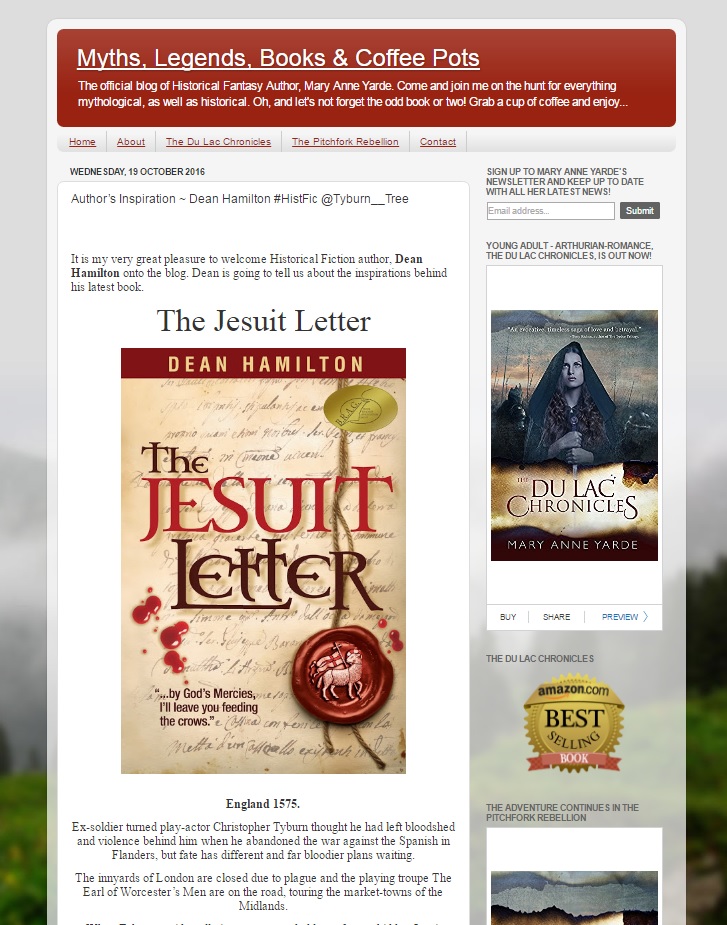 Check out my new article on the ideas and sources that inspired THE JESUIT LETTER, posted on Mary Anne Yarde's terrific book blog Myths, Legends, Books & Coffee Pots.