Elizabethan London

Elizabethan London
Tyburn was an infamous execution spot west of London, used since medieval times. The Tyburn "tree" - a unique, multi-person gallows - erected in 1571 became a popular public spectacle, drawing crowds of thousands.Tyburn Tree blog is less blood-thirsty but hopefully topical, interesting and informative, if slightly bent to my personal topics of interest - books, writing, history, technology, with a smattering of politics and dash of pop culture, science and the downright strange. So "take a ride to Tyburn" and see what happens...

Friday, May 31, 2013

King in the Car Park


Wired has a neat gallery of photos (and links) regarding updates on the recent discovery of the skeletal remains of Richard III under a car park in Leicester.

If you, like me, you have an unhealthy obsession with both archaeology and the Tudor eras, you will be excited....

Check it out here.

Monday, May 13, 2013

Coming Home....


Cmdr. Chris Hadfield is on his way back down from a five month stint as Commander of the ISS.  He has probably done more for the education, popularization and visibility of the space program than anyone in recent memory (including Mohawk guy from JPL).  Before leaving, he recorded (with David Bowie;s permission) a new cover version of "Space Oddity".   If you do nothing else today, give it a listen and take a second to marvel at all aspects of this - recorded from orbit!

Thursday, April 4, 2013

"...bitter as salt and stone...."

All that you held most dear you will put by
and leave behind you: and this is the arrow
the longbow of your exile first lets fly.

You will come to know how bitter as salt and stone
is the bread of others, how hard the way that goes
up and down stairs that never are your own.
Paradiso -Dante


Damn.  That dude can write.

Monday, March 18, 2013

Historical Fiction: Delving into the Age


"Kit Tyburn leaned on the bench, his back pressing against the canted timbered wall, surveying the four pasteboard cards in his hands critically.  A worn cyclopean knave of hearts gazed back, accompanied by two clubs, four hearts and a wistful diamond queen."  - Excerpt, The Jesuit Letter


Historical fiction is a genre that often carries the illusion of ease in its genetic code.  To the uninitiated, it is simpler to pull from the pages of history - you don't need to invent, you don't need to create, you just need to pillage the past.   It's all there for the taking.

The reality is that historical fiction requires hard research, a critical eye and the ability to parse from history the day-to-day norms and conditions that govern your characters and your settings.  History buffs are often well-versed, very particular and on occasion, will obsessively guard their "eras", noting any permutation or deviation with judicious care.  Obvious errors pull the reader out of the period and the setting, detracting from the story-line and the overall credibility of the tale.  Research, context and, more importantly, being able to reflect and mirror the feel for the era in the story, are critical elements in making historical fiction work.

That is not to say that you cannot bend history to suit story.  Indeed, it often becomes a necessity.  Good historical fiction winds its way through reality with deft prose and respect for the era and its fundamentals but in fiction, the need to cut, edit and interpret history to serve your plot comes up more often than you think.  Both geography and time need to bend to the will of the author if the story demands it but in a way that ideally respects the reader, the era and the circumstances.  You can move a hill, shift a date, add a character to a critical time and place, but you need to avoid anachronisms and blatant or egregious retro-fitting of history if you want to keep the interest of your readers, and your own credibility...

Writers of historical fiction often need to embed their story in as much reality as it can bear, but not too much.  Most readers don't really want a story that reflects a well-loved character dying of dysentery or an infection from a tooth abscess.  You don't need to know about the toiletry habits of the typical Roman, or how infrequently people in the Middle Ages bathed - unless it is specific and particular to advancing the plot.  When writing historical fiction, the copious research and meticulous attention needs to be levied with the need for story, advancing your plot, and a strong,  vivid and evocative tale to tell, not the reality of medieval sanitary conditions

Writers need to be careful that research doesn't overwhelm storyline.  It is very easy to suffer from excessive inclusion - the need to make certain that your depth of research is reflected on the page - driving the reader to distraction with miscellaneous detail and context that is unneeded and fails to drive the plot.  It is very easy to get distracted by the need to explain and the temptation, when a terrific piece of research needs to be incorporated into a scene, to make the scene about the research rather than the character or the story.  When an everyday event takes you days or weeks to research and plan, the urge to have that fictional moment encompass more to justify all the hard work that went into it, can be an easy and common trap for the writer.  The excerpt above opened a brief scene of card-play that took up a total of two and half pages, mostly dialogue, intended to advance the characters and their situation.  It also involved a significant amount of detailed research into playing cards, their use in Elizabethan England, the types of playing cards available and detailed rules for several different card games, research that included about thirty hands of primero at the kitchen table to get the gambling and betting elements correct.  The original version was almost double in length and covered several hands worth of play, until I re-read it and decided that the vast majority of non-primero playing readers would find it tedious.  Cut-down in its prime, the research lives but much reduced.  Similarly a scene with a dog-fight was cut entirely, even though the intriguing and fascinating world of badger-baiting did beckon seductively.

Historical fiction is best when the author is painting in the corners, dropping in the innocuous and oft un-noted details that help make the era and the landscape come alive in ways that the reader barely overtly notices, but builds and supports the overall world and setting.  It is found in the canted timber walls and the worn pasteboards, the sour warm ale and the mud-caked cobbles, the taste of spiced wine and the rancid stench of a urine-soaked alley.  The research must lead the writer, helping him enter into that world, where they can critically pick the elements and moments to entrap in prose, pulling the reader into their time-warp, into a world and an engrossing story.

It's all about painting in those corners.

Monday, February 4, 2013

Curtail’d of this fair proportion - Richard III

I, that am curtail’d of this fair proportion,
Cheated of feature by dissembling nature,
Deform’d, unfinish’d, sent before my time
Into this breathing world, scarce half made up,
And that so lamely and unfashionable
That dogs bark at me as I halt by them;…
                                       - Act I, Scene I, Richard III, W. Shakespeare

The University of Leicester has formally identified the remains it recovered recently under a car park at Grey Friars, Leicester as Richard III, King of England, 1483-1485, the last of the Plantagenets.

The BBC has ample coverage (and a terrific gallery of images from which the above was sourced).  From an archaeologist's perspective, the research that uncovered Richard III has demonstrated how history, archaeology, genetics and science can cross-pollinate spectacularly to unearth a 528-year old mystery.

Richard III is probably one of history's most controversial and notorious monarchs, fueled by a vivid and villainous portrayal by William Shakespeare among others, who had a vested interest in buttressing and justifying the subsequent Tudor rule from Henry VII to Elizabeth I.  Whether Richard III was guilty of the crimes that history has tarred him with (namely the disappearance and probable deaths of his brother's two young children so he could secure the throne by almost literally stepping over their corpses) will probably never be completely known, but the Richard III as a character, as a metaphor for unchecked ambition and ruthless endeavor is everlasting.

Someone commented "So what?  What does it matter to us today?" on one news article, a bit of sophistry that infuriates me.  As the old adage goes, those who forget their past are condemned to repeat it but beyond that aphorism lies a deeper understanding:  having an appreciation and comprehension of the past allows you to connect with and understand the forces that drive the present, the long ribbon of connectivity and effect that provides context and knowledge.  History is that shared experience a society carries that helps facilitate its very foundation.  Having a clear understanding of the drivers and fundamentals of your own society necessitates a grasp of history, of knowing the whys and whats of the past, in order to determine your future.

The recovered skeletal remains bear the marks of ten wounds, eight to the head alone, a testament to the fury and chaotic violence of the medieval battlefield.  Richard III will be laid to rest again in Leicester Cathedral, a somewhat more dignified fate then he suffered in death, having been hauled off Bosworth Field, paraded around and dumped into a grave at Greyfriars Church, supposedly without ceremony and in an unmarked grave.  Without a doubt, Leicester will build a museum and experience a nice tourism upheaval in the wake of the discovery, at long last "made glorious summer by this sun of York."


Thursday, January 17, 2013

To Simpson or Not to Simpson...

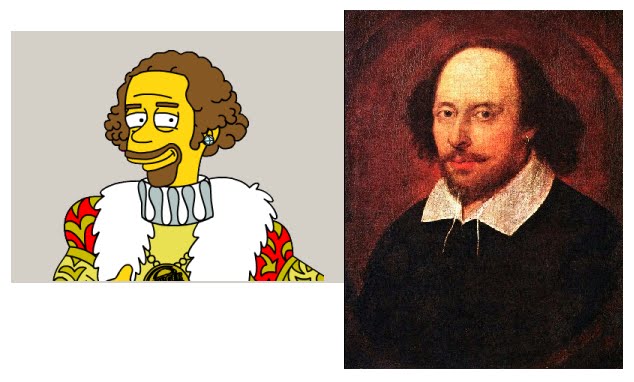
 A few years back, when The Simpson's Movie first came out, someone (I assume some movie marketing company) put up a "Simpsonizer" online. 

Briefly, the Simpsonizer allowed you to upload a personal photo and "Simpsonize" it, granting the recipient a cartoon rendition of their photo transmuted into the permanent state of jaundice that is the typical Simpson's character.

After working my way through a panoply of relatives and work-associates photos, I decided to immortalize The Bard as a Simpson's character using the famous Chandos portrait

Simpsonized Shakepeare


It didn't come out too bad.

Unfortunately the Simpsonizer has vanished from the Internet, so I am unable to Simpsonize the cast of Game of Thrones...