Elizabethan London

Elizabethan London
Tyburn was an infamous execution spot west of London, used since medieval times. The Tyburn "tree" - a unique, multi-person gallows - erected in 1571 became a popular public spectacle, drawing crowds of thousands.Tyburn Tree blog is less blood-thirsty but hopefully topical, interesting and informative, if slightly bent to my personal topics of interest - books, writing, history, technology, with a smattering of politics and dash of pop culture, science and the downright strange. So "take a ride to Tyburn" and see what happens...

Saturday, April 1, 2017

Shakespeare at the Movies: Ran

Ran (1985)

Director: Akira Kurosawa
Stars: Tatsuya Nakadai, Akira Terao, Jinpachi Nezu


“As flies to wanton boys are we to the gods. 
They kill us for their sport.” 
-Shakespeare, King Lear

Ran is one of acclaimed director Akira Kurosawa’s most visually stunning films. An epic, bloody, colourful, and apocalyptic piece of celluloid, the film garnered Oscar nominations for Best Director, Art Direction, Cinematography, and Costume Design (won!).

Ran (the Japanese word for “Chaos”) is loosely based on King Lear, Shakespeare’s cautionary tragedy focused on the dangers of power, succession, family ambition, madness and loyalty.

Ran tells the tale of Hidetora Ichimonji, a powerful but aging warlord who decides to retire from ruling and divide his kingdom between his three sons. Hidetora will retain his role as the Great Lord.  His son Saburo objects, noting that Hidetora himself often used questionable means to retain power and to expect his sons to remain loyal was foolish. For his pointed advice, Saburo is exiled and the lands divided between the two remaining sons.

As expected, once the power is divided among his remaining two sons, Hidetora is ousted as Great Lord, flees to the Third Castle (empty as it belongs to the exiled Suburo. Besieged in the castle by the armies of his two sons, his samurai slaughtered, the castle in flames, Hidetora succumbs to madness and escapes the conflagration, to end up wandering the wilderness, haunted by visions of the many people he had butchered in his quest for power.

Son #1 (Taro, the eldest) is killed by Jiro (Son #2)’s general, and Jiro, naturally enough, steps up to assume the position of Great Lord. He also ends up in an affair with his dead brother’s manipulative widow Kaede, who tries to suborn him into murdering his own wife, who flees. At this point Jiro also decides to dispatch assassins to finish off his troublesome (and now quite mad) father Hidetora.
At this point, not one but three armies are entering the field – Saburo (Son#3), re-appears alongside two rival warlord allies. Jiro makes a hasty peace but then promptly backstabs his meddlesome brother as soon as his brother hears that Hidetora is alive and insane. Saburo rides off to rescue Hidetora, Jiro looses his assassins, rival warlords and armies clash and in short order Saburo recovers Hidetora, mends his broken relationship, helps him recover from his madness, just in time to be promptly and thoroughly murdered by Jiro’s assassins.

Whew.

Hidetora dies, stricken by the loss of his only loyal son. Jiro’s fugitive wife dies, murdered by assassins. Jiro’s general Kurogane (who so kindly took care of Son #1 for Jiro) finds out about how Son #1’s widow manipulated events and promptly decapitates her in a fit of honourable angst.  In a final bloody, flaming conflagration, Jiro, Kurogane etc. all go down in a blaze of…well, not glory for sure, chaos springs to mind, when the rival warlords besiege the castle in the final doomed battle.
In any case, there is a great heap of bodies, a nice funeral procession and some sad symbolic irony at the end.

So wow.

Visually dazzling, Ran is an epic, sweeping, stylistic rendering of the Lear tale, pulling out the themes of war, chaos, loyalty, madness and nihilism into a masterclass of film. Ran is chock full to the brim with suffering, horror, murder, hypocrisy, and the doomed.

Lear was written by Shakespeare in 1606, a time of particular caution in England as Queen Elizabeth had died childless and unmarried in 1603.  She was succeeded by the young King of Scotland James I, son of her executed rival Mary, Queen of Scots.  The advent of a new King, after 44 years of Elizabeth's rule, was a shocking herald to a new age and a new political reckoning.  It was not helped by the bloody aftermath of the Gunpowder Plot  in 1603, a failed assassination attempt on Parliament and the new King that shook the foundations of the nation to its core.

The nature of power, succession and how a kingdom can teeter into chaos dominates the themes of Lear, bringing the differences and potential dangers faced by the new regime into sharp focus. Kurosawa himself noted that Ran was intended as a powerful metaphor for nuclear war and the grinding, systemic and industrial quality inherent in the advent of modern warfare. It is notable in that it is a samurai epic where almost every important figure dies by gunfire, not by sword.

It is a telling story. And one well worth a watch.


“This is the excellent foppery of the world, that,
when we are sick in fortune,--often the surfeit
of our own behavior,--we make guilty of our
disasters the sun, the moon, and the stars: as
if we were villains by necessity; fools by
heavenly compulsion; knaves, thieves, and
treachers, by spherical predominance; drunkards,
liars, and adulterers, by an enforced obedience of
planetary influence; and all that we are evil in,
by a divine thrusting on: an admirable evasion
of whoremaster man, to lay his goatish
disposition to the charge of a star.” 
― Shakespeare, King Lear

Saturday, February 11, 2017

Discovered Diamond!

Good news!

THE JESUIT LETTER has been deemed a "Discovered Diamond" in a new review site called, naturally enough, Discovering Diamonds.

Go take a look, check out the review, and I recommend sticking around and reading some of the other reviews because there is lots of good histfic on display.


Tuesday, January 31, 2017

Review: The Bernicia Chronicles – Matthew Harffy


I’ve been hugely remiss in my book reviews in the last year. So as my act of contrition, I’m giving you a three-for-one and reviewing Matthew Harffy’s excellent, shieldwall-busting series, The Bernicia Chronicles.

The Bernicia Chronicles encompasses the familiar world of post-Roman Britain, replete with war-ravaged kingdoms and piecemeal domains. Savaged by warbands and raiders, rife with violence, alliances, shifting allegiances, and nascent Christianity, the series dives deep into the chaos of 633 AD and brutal life in Northumbria. To some writers this might seem to be a difficult hill to climb, given the number of excellent authors that have books set in post-Roman / pre-1066-and-all-that Britain but Harffy makes it look easy. Take a fascinating era, great characters, solid plots and mix it with a heady amount of sword-swinging carnage.

THE SERPENT SWORD is the first book in the series, introducing the main character Beobrand, a young man thrust into a bloody quest for vengeance when his older brother is murdered. The first book lays out a gripping and compelling tale that sees Beobrand develop from inexperienced newcomer into a capable, and at times, berserker-fueled,  warrior.

Harffy weaves a solid and believable story and Beobrand is a great character, one whose imperfections and temper often lead him into potentially dark choices that many fictional characters dare not go but Harffy captures his moral dilemmas with both verve and humanity.  The landscape and the world of Northhumbria are drawn out with care, as are the terrifically written battle and fight sequences.  Harffy does a good job drawing the reader into Beobrand’s world and making the story organic to the history and the setting.

THE CURSE & THE CROSS, the second book in the series, picks up Beobrand as an established warrior, now a respected (and feared) leader of his own band of warriors.  Beobrand has to learn how to manage the leadership of his small community, balance his service to his overlord King Oswald, his own uncertain temper and violent tendencies, and fulfil his obligations to home, family  and personal honour.  Beobrand is a character who's flaws writ large at times, giving him unexpected nuance in what could easily have been a very formulaic tale and stereotypical character. Harffy deftly avoids this trap, making the reader interested in delving deeper into Beobrand’s problems and story and giving his character a strong arc and development.

Harffy continues in this book  with solid and excellent historical world-building,weaving the rise of Christianity and the slow erosion of paganism into the bleak landscapes of Northumbria, bringing its often unpredictable inhabitants to vivid life.


BLOOD & BLADE is the third installment in the series and continues building on the solid narrative foundation Harffy has constructed in the first two books. Beobrand has grown as a character – in both his traits and his role. When Oswald, King of Northhumbria cements an alliance with Wessex by marriage, Beobrand is tasked with what seems like the simple responsibility to escort his new Queen back to Bebbanburg. For Beobrand, nothing is ever simple or how it seems and he soon finds himself entangled in a dangerous situation.

Rife with battle, characters and superlatively  immersed in the era, Harffy has, as with the previous books, presented a great story that will have you turning pages late into the night. I lost sleep on this one.

In conclusion, if you are looking for a great set of books to take you out of the present, and set you loose on the cold and brutal hills of Northhumbria, The Bernicia Chronicles are the way to go. Excellent characters that develop from book to book in depth, sophistication and emotional impact, a terrific historical setting and tautly written prose that rings like swords on steel.

Go get them!

Sunday, January 29, 2017

#AmWriting

Achievement unlocked!

"Tyburn cursed aloud, first in English & then in his best gutter Dutch, something he usually reserved only for special affronts."

50,000 words done on THIEVES CASTLE!

All downhill from here!

Tuesday, January 3, 2017

Start 2017 Right!

A little promo, to start the #NewYear right:

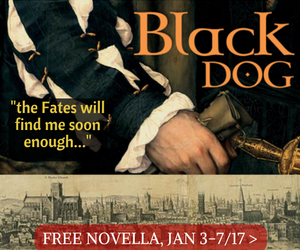
BLACK DOG is FREE on #Kindle from Jan 3 -7, 2017!


http://amzn.to/2iAYsez 


Tuesday, December 27, 2016

Happy Holidays!

Wishing everyone a very Merry Christmas and a Happy New Year!

Monday, December 12, 2016

Shakespeare at the Movies: Forbidden Planet

Forbidden Planet (1956)


Director: Fred M. Wilcox
Stars: Walter Pidgeon, Anne Francis, Leslie Nielsen


“This thing of darkness I 
acknowledge mine.”
– Shakespeare, The Tempest

Forbidden Planet is bit off my usual beaten track for Shakespearean films.

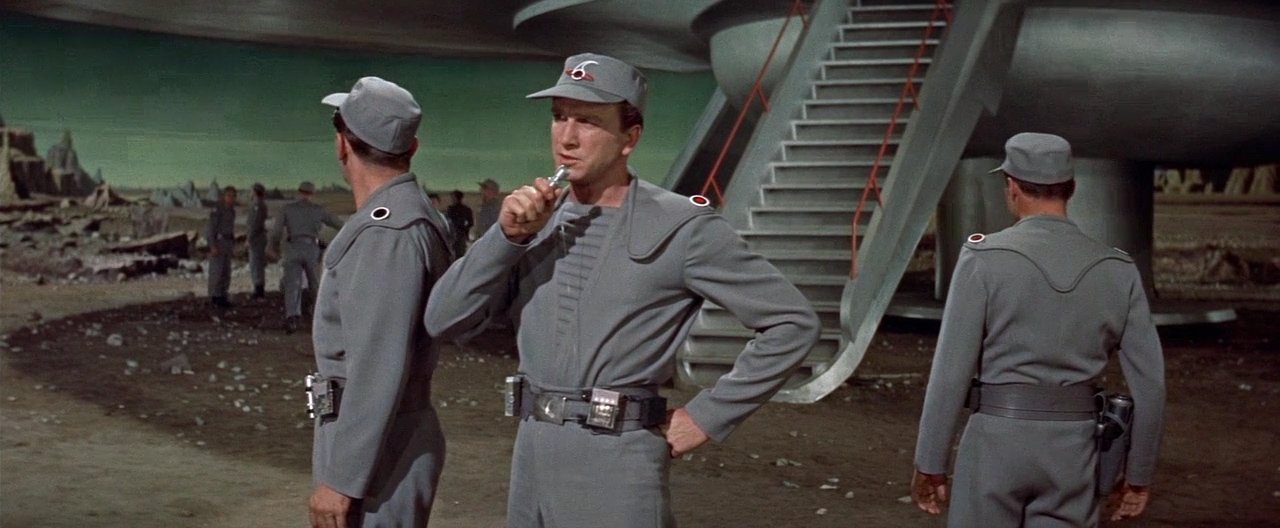
The movie retells Shakespeare’s The Tempest, replacing Prospero’s magical isle with the strange and mysterious Altair IV, once home to an ancient and long-defunct race of alien beings called the Krell. Marooned on the planet is Dr. Morbius and his daughter Altaira, the sole survivors of a scientific expedition that vanished 20 years before.


The starship C-57D (not really the most evocative of names) arrives with a crew of eighteen under the command of Commander John J. Adams (played with perfect seriousness by a young Leslie Nielson). Tasked with investigating the scientific expedition’s disappearance, the crew lands on Altair IV, quickly making contact with Dr. Morbius (played by Walter Pidgeon), his robot minion Robby and his now grown daughter (Anne Francis). Morbius is increasingly put out by Altaira’s fascination with the young men and their commander (well, as “fascinated” as you can be for the 1950s censors, I suppose….). In turn, Adams and his officers are puzzled by the sophisticated technology that Morbius seems to control, including his robotic servant Robby (who rapidly ends up serving as a bootlegging source of whisky for the crew).


“Another one of them new worlds. No beer, no women, no pool parlors, nothin'. Nothin' to do but throw rocks at tin cans, and we gotta bring our own tin cans.”


Morbius reveals that the planet was once home to an alien species, the Krell, that vanished nearly 200,000 years before, leaving their technology, their underground network of machines and a special learning library behind. Morbius has used the learning library to extend his intellect far beyond that of normal men, enabling him to master new technologies.

In the meantime a strange invisible intruder has sabotaged the starship, an incident that rapidly escalates to the murder of a crewman. Protecting the starship with a special forcefield, the crew ineffectively battles the strange invisible monster, ending up with several dead. Strangely the creature vanishes when Morbius awakens from his sleep. One of the ship’s officers, Ostow, suspecting Morbius, sneaks in and tries out the Krell “educator” and is fatally injured by the alien technology. Before he dies, he informs Commander Adams that the Great Machine was built to provide the Krell with anything they could imagine, but that they had made a dreadful error: “Monsters from the Id!” The creature was a manifestation of Morbius’s subconscious mind brought to life by the Krell technology.

    “And yet always in my mind I seem to feel the creature is lurking somewhere close at hand, sly and irresistible and only waiting to be reinvoked for murder.”

“And so those mindless beasts of the subconscious had access to a machine that could never be shut down. The secret devil of every soul on the planet all set free at once to loot and maim.”

Adams and Altaira declare their love, Morbius naturally enough, oppose it, the monster rampages anon, the lovers escape in the starship, poor Robbie is fried by his own programming, and Morbius finally admits his mistake and guilt in destroying, unconsciously, the first expedition. He sets off a chain reaction in the Krell reactors, destroying Altair IV and the Krell monster forever.


The film doesn’t not so much directly channel Shakespeare, but certainly provides one of the many, many derivative works inspired by and leveraging the famous works of the Bard. Most of the key roles are almost directly transferable: Morbius as Prospero, Altaira as Miranda, Adams as a wooden-faced Ferdinand, and Robby the Robot as the mischievous spirit Ariel. Released by MGM in 1956, it was, at the time, the most expensive science fiction film ever attempted, and pioneered a number of special effects and tropes that went on to become staples of the genre.  The film served as a break-out role for Leslie Nielson, who later leveraged his dead-pan delivery to his more infamous comedy roles as the doctor in Airplane and the hapless Frank Drebin in the Naked Gun series. Prior knowledge and experience of his comedic roles lends a certain hidden verve to his fairly flat, melodramatic and square-jawed space commander.

Forbidden Planet became a hugely influential science-fiction classic, directly contributing to the development, look and feel of Gene Roddenberry’s Star Trek series in the following decade and numerous other television shows and films. It ushered in an era of more serious, more grounded science fiction film, and introduced possibly one of the most influential depictions of a robot in film, laying the groundwork for 2001’s HAL9000, the personable and murderous computer support for the doomed Jupiter expedition.

Among other notable achievements, Forbidden Planet’s unique musical score – the first totally electronic composition – paved the way for a long list of science fiction musical compositions including Vangelis’s terrific score for Blade Runner.

In short, Forbidden Planet is a fairly shallow and derivative, but fascinating, spin-off of  The Tempest, one I suspect Shakespeare would recognize readily enough. Don’t expect the same depth of character, dialogue or an evocation of the “rough magic” The Tempest provides, but if you watch carefully, you can glimpse it in key moments, flashing past like flickering quick-silvered starlight.

“How beauteous mankind is! O brave new world, that has such people in it!”
― William Shakespeare, The Tempest